
Dearborn Previous Residents Sources
A Dearborn backward address trail changes sources as it crosses eras. The Wayne County Register of Deeds supplies recorded conveyances and legal descriptions. Dearborn's local directories place listed households along streets. Federal census schedules add relationships and ages. The Dearborn Museum's survey cards and Dearborn city permits can date the building or an alteration without claiming who occupied it. Use the source that answers the dated Dearborn question at hand.
| Source | Years It Covers | Where Held | What It Shows |
|---|---|---|---|
| Wayne deed web guidance | 1960 forward under the search-and-copy guidance; current portal material also emphasizes post-1986 documents | Wayne Register of Deeds and GovOS Cloud Search | Dearborn conveyances, liens, mortgages, legal descriptions, and recording trail |
| Wayne physical land records | Records physically date to 1703 | Register of Deeds office and archive route | Earlier Dearborn grantor-grantee books and instruments |
| Dearborn Polk and Bresser directories | 1926-27 through 2007-08 in non-continuous listed runs | Henry Ford Centennial Library, Dearborn Historical Museum, and DGS-listed shelves | Street, listed household head, phone, occupation, and owner-renter clues |
| Federal census | 1790-1950 released | NARA and historical census releases | Dearborn household composition, age, relationships, and address context |
| Dearborn Historical Museum survey cards | 1979 project for structures built 1929 or earlier that survived | Dearborn Historical Museum archive | Building photograph and survey context, not a current resident list |
| Dearborn permits and newspapers | Current permit module; newspaper runs vary by title | BS&A, Dearborn city departments, library PDFs, microfilm, and catalog | Work dates or public notices that can narrow a change in time |
The table is a Dearborn records route, not a promise of continuous coverage. The Dearborn directory holdings have gaps. Web deed language also uses more than one date, so save the search date and mode with every result. A missing record may mean the search needs a different name, legal description, office request, or historical Dearborn label.
Freeze a Dearborn Parcel First
Before tracing Dearborn previous residents, capture the current Dearborn property identity. Dearborn's Residential Property Assessment Database through BS&A advertises address, name, and parcel-number searches. Record the modern situs address, parcel or tax ID, subdivision, lot and block when shown, legal description, current owner, mailing address, assessment values, exemption indicators, and latest sale entry. A Dearborn situs address is the physical location. A mailing address is where tax correspondence goes and may be elsewhere.
A Dearborn parcel ID and legal description usually survive a changed street label better than an address alone. The legal description identifies the recorded land, often through a subdivision, lot, block, or survey language. A Dearborn property card can list an owner, but title does not establish every person living at the house. A mailing address is likewise a correspondence clue, not proof of occupancy.
Dearborn Deed Records for History
The Dearborn deed chain is the ownership spine. In Wayne County, find the present owner of the Dearborn parcel as the grantee, the party receiving a purchase deed. Read the instrument for the seller or grantor, the party conveying the property, plus the recording date, document number, liber and page, and legal description. Then search that seller as a grantee to find the earlier acquisition. Repeat only after confirming that the land description still matches the Dearborn parcel.
- Search the current owner in the Wayne Register of Deeds index as grantee and identify the purchase instrument.
- Copy the legal description, recording date, document number, liber and page, Dearborn parcel information, and seller's name.
- Search the seller as grantee to locate the seller's earlier acquisition.
- Compare the Dearborn subdivision, lot and block, parcel or tax ID, and legal description before adding another link.
- Search both spouses, trusts, and business names when the instrument identifies them.
- When an address hit fails, use the older Dearborn-area street label, exact party name, legal description, or liber and page.
- Grantor and grantee
- The grantor transfers an interest in land. The grantee receives it.
- Chain of title
- The sequence of recorded transfers for the same parcel or legal description.
- Liber and page
- A volume and page reference used in older land-record indexing. It helps reconnect a document when a street search is unreliable.
- Criss-cross directory
- A street-and-house-number arrangement that helps connect an address to a dated household listing.
Dearborn Deed Record Access
Wayne County's online cutoff deserves careful wording. The search-and-copy guidance says recorded documents can be searched and printed online from January 1, 1960, but the County home page separately directs users to documents recorded after 1986 and the current GovOS system has its own account rules. Treat 1960 as historical online guidance, not a guarantee that every image or search feature will be available.
The free public search is name-only for grantor or grantee listings. Address, legal-description, parcel or tax-ID, liber-page, and full image access are associated with a paid session. Earlier Dearborn instruments require the Register of Deeds office or a search-by-mail request. County materials list an office property search at $5, waived with proof of personal residence, and search by mail at $15 per address, with copy and certification charges stated separately. Verify the current portal and office policy before paying or traveling.
The Wayne County deed-index search is the current GovOS entry point captured for this Dearborn address-history route.
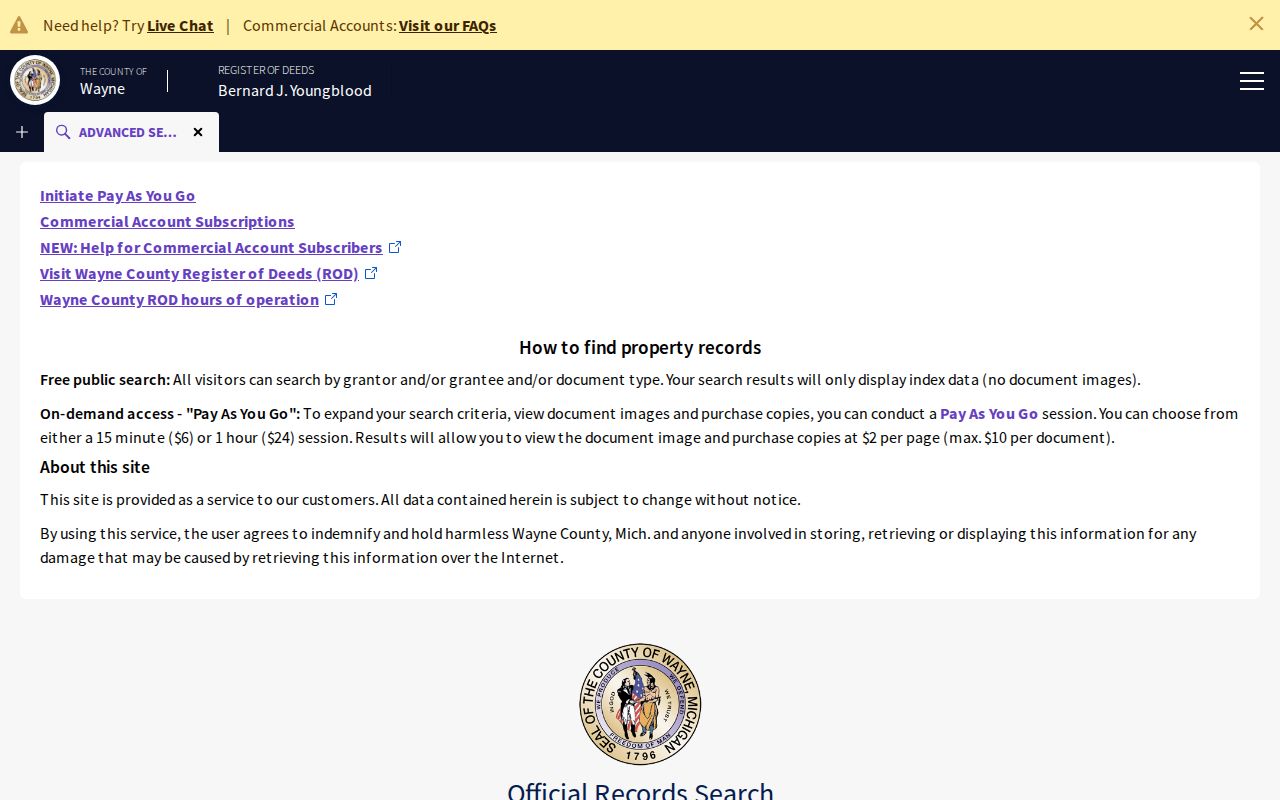
The capture shows the public land-record search landing page. Use it to begin a Dearborn recorded-party index search, then preserve the legal description and document identifiers that connect a result to the same Dearborn parcel. It does not turn a Dearborn deed into a list of every household member.
Record boundary. A Dearborn deed establishes recorded parties and a conveyance. It may name a spouse, trust, lender, attorney-in-fact, or company, and it does not identify every occupant. Use the Dearborn chain to study ownership, then turn to dated household sources for previous residents.
Dearborn Directory and Census Flow
Ownership is only part of Dearborn address history. The historical Dearborn city-directory collections are covered in detail on the Dearborn City Directory page. For an address-first search, use a Polk street section or Bresser criss-cross section for the closest available Dearborn directory date. Polk can add household, occupation, and owner-renter information. Bresser may identify a head of household, phone, owner-renter notation, year first listed, or relocation clue.
- Choose the listed directory year closest to the transfer or household period being tested.
- Search the Dearborn street section by house number, then check the surname section for names, occupations, and family notation.
- Compare the prior and next available listed editions. A gap is not evidence that the Dearborn house was empty.
- Pair the directory with the nearest released 1930, 1940, or 1950 census schedule.
- Use the census for relationships and ages, and the Dearborn directory for address, phone, occupation, and owner-renter clues.
- Resolve differences by date because a census and directory were compiled at different times.
NARA's 1940 finding aid identifies Dearborn enumeration districts 82-22, 82-23, 82-248, and 82-24 through 82-41. An enumeration district is the area assigned to one census taker. The best way to use those references is to establish the historical address and municipal label before opening a census roll.
Fordson Names in Dearborn Records
Dearborn's municipal history is a continuity problem for former-address research. Springwells became Fordson in 1925. The City of Dearborn and Fordson merged on January 15, 1929. The directory sequence shows the transition: a Dearborn street guide in 1926-27, Polk Fordson in 1928, and a Dearborn volume in 1928-29.
Search Fordson, Springwells, Dearborn Township, and Dearborn before deciding that an old address has disappeared. The same Dearborn historical rule applies to deeds, newspapers, maps, and census work. When a street title has changed or the address is unclear, the legal description and parcel history are the better bridge.
Dearborn Building Records and Survey Cards
The Dearborn Historical Museum offers appointment research through archives that include Polk directories, local newspaper microfilm, government photographs, early records, and 1979 survey cards. The cards photographed every Dearborn structure built in 1929 or earlier that was still standing when the project was made. They can add a building image and address context beside a deed's legal description and a directory's household listing.
Dearborn's permit systems provide a second time marker in Dearborn. The City of Dearborn identifies building, mechanical, electrical, plumbing, demolition, renovation, and new-construction workflows, and BS&A may expose address, applicant, contractor, owner, inspection, and completion fields. The confirmed public historical range and exact visible fields are not known, so verify a result before treating a permit as evidence. A permit can bracket construction or an alteration; it does not prove that an applicant lived at the property.
Fire-insurance maps can add building footprint, lot coverage, outbuilding, and street-context information. The Library of Congress guide supports a place, date, and sheet search, but the research did not confirm a distinct online Dearborn Sanborn set or its available years. Treat a map as building context, not as a household register, and confirm the exact Dearborn city, sheet, and date before linking it to a prior address.
Dearborn Previous Residents Endpoints
When the address trail reaches a death, estate, or move, Dearborn newspapers and probate can help test the transition. An obituary may state a death date, relative, funeral home, former address, or organization. Wayne Probate Court Case Access and a WCPC81 copy request can identify a decedent, personal representative, heirs, and estate address when the material is public. A later deed can then show a distribution or sale. Protected and sealed probate matters are not open.
Dearborn library newspaper holdings cover several overlapping titles and formats. A no-hit obituary request is not conclusive. No official online city interment index was found, though historical collections may hold cemetery transcripts and plat maps. Match every endpoint back to the parcel's legal description and historical city label before connecting it to a previous household.
Lawful personal use. Use previous-resident research for house history, family history, estate questions, or personal curiosity. Do not use records to track, impersonate, contact, or harass a living person, especially someone who has asked for no contact. Michigan protections can also limit access to voter, driver, utility, court, and address-confidentiality information.